


自迁移出 MediaWiki 以来,本页内容尚未经过审查。如果您愿意帮忙,请查看帮助指南!
简介
虽然 BigStitcher(使用BigDataViewer)非常适合显示图像结果和手动检查数据,但其他 ImageJ 插件或不同程序的后续处理步骤通常需要“经典”(单个)图像(BigDataViewer 显示的彩色“图像”是根据输入图像即时计算的,而不是保存)。
从多个变换/扫描的输入图像创建单个图像堆栈的过程称为图像融合。我们提供了两种在 BigStitcher 和 Multiview-Reconstruction 中创建图像融合图像的方法:
快速融合
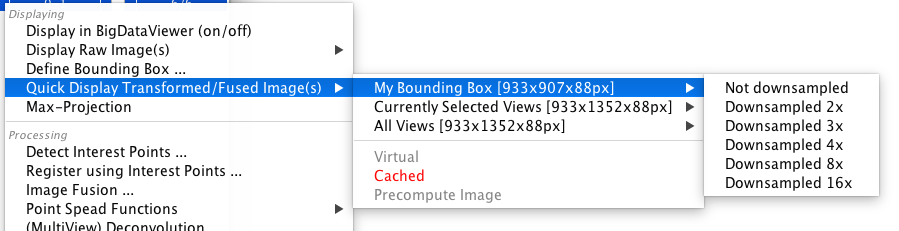
从拼接(第§§0§§§下)和多视图模式(第Displaying下)的主菜单中选择“快速显示变换/融合图像”可以快速访问。
选择菜单项将打开一个子菜单,其中显示所有Bounding Boxes以及融合模式(虚拟、存储或预计算图像,详细信息见下文)。
当前选择的融合模式以红色突出显示,同时另一个融合模式将切换到该模式。
最后,选择边界框将打开另一个子菜单,您可以在其中选择要融合的下采样级别。只需所需级别以融合图像并在新的 ImageJ 窗口中显示结果。
The quick fusion will fuse all selected images, including multiple channels/illuminations/time points, into one final image. To prevent e.g. a fusion of multiple channels, make sure to select only the images you need, ungrouping the views in the main window, if necessary.
高级融合
对于高级融合选项,请在主窗口中选择要融合的所需视图,然后单击右键菜单中的“融合图像…”。
这将弹出一个新的对话框,显示融合选项:
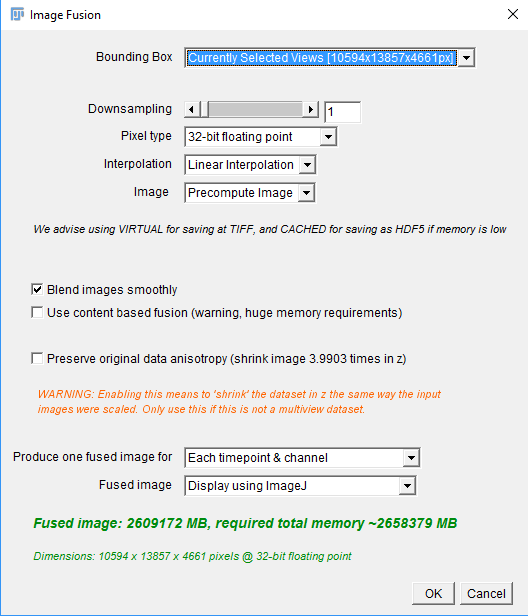
- 您的边界框:在这里,可以选择要融合的数据集的哪个子卷(Bounding Box)。即使您没有手动指定边界框,所有视图和当前选择的视图选项仍然可用。
- 下采样: 对图像进行下采样的因子(在每个维度)。请注意,生成的图像在 x、y 和 z 方向上将具有相同的像素大小,除非您选择保留原始各向异性(见下文)。
- 像素类型:是否产生16位无符号整数或32位浮点输出。 32 位结果需要两倍的磁盘/内存空间,但可以准确表示融合的非整数结果。选择 16 位输出会将输出向下舍入到下一个整数(整数)。
- 插值: 由于在对齐过程中各个图像可能会移动到子像素位置,因此我们必须使用 插值 来确定结果图像的像素处的强度值。您可以选择是否执行最近邻(更快,稍微“像素化”的结果)或线性插值(更平滑的结果,稍微慢一些)。
- 图像: 如何在内存中创建结果图像,可以是:
- Virtual: Display or start saving the fused stacks immediately, calculating each plane on-the-fly. This way, you can fuse images larger than your computers RAM, but if you switch between planes, the calculation has to be repeated every time.
- Cached: like virtual, but keeping previously calculated planes in memory. The caching introduces a small computational overhead but for displaying, this is a good compromise between the unresponsive virtual mode and the memory-hungry pre-computed mode.
- Precompute Image: Calculate the whole fused stack before displaying or saving it. This might take a significant amount of time and have large memory requirements if you fuse large volumes, but the calculations have to be done only once.
- 平滑地混合图像: 融合过程是输入图像的 加权平均值。平滑混合会导致输入图像的边界像素上的权重减少(余弦形淡出)。如果取消选择此选项,融合将简单地对每个点的图像进行平均,从而在某些情况下导致可见的图像边界(例如照明不均匀)。
- 使用基于内容的融合: 选择此选项可额外对要按输入图像的局部熵进行平均的像素进行加权,从而更加重视具有更多结构/更少模糊的图像。使用此功能可以在某些输入图像模糊的区域(例如,因为它们远离目标)获得更好的结果。因为我们必须为基于内容的融合计算额外的权重图像,这大大增加了内存需求。
- 保留原始数据各向异性: 默认情况下,融合图像在 x、y 和 z 上将具有相同的像素距离。对于非多视图图像(例如,当从一个角度拼接“正常”平铺采集时),这通常会在 z 中构成不必要的上采样(如果原始 z 像素距离大于 x 和 y 中的像素距离)。通过选择此选项,我们将使用融合图像的原始像素大小。融合多个角度时此选项不可用。
- 生成一张融合图像: 为了不将所有选定视图混合到一张图像中,Fusion 可以融合选定视图的不同子组,选项包括:
- Each timepoint & channel: produce one output image for each timepoint and channel combination (fusing tiles, angles and illumination directions)
- Each timepoint, channel & illumination: produce one output image for each timepoint, channel and illumination direction combination (fusing tiles and angles)
- All views together: fuse all input views into one image. Take care not to select, e.g. multiple channels, in the main window as they will all be fused together (unless this is specifically what you want).
- Each view: produce one “fused” image for each input image. This will create an image of the bounding box with the view placed according to the transformations determined in the previous steps.
- 融合图像: 如何保存或显示融合图像。选项有:
- Display using ImageJ: Keep the results in memory and display them as “classical” ImageJ images. Use this if you want to immediately process the results further or save the in a different format using the export options of ImageJ.
- Save as (compressed) TIFF stacks: Save the results immediately to TIFF stacks. The resulting files will be put in the same directory as the current project XML file.
- Save as new XML project (TIFF): Save as TIFF stacks and also create a new XML project for them (useful if you want to visualize them again using BigDataViewer, but still need “simple TIFFs” for other processing steps).
- Save as new XML project (HDF5): Save the results to a multi-resolution HDF5 file and create a new XML project file for them.
- Append to current XML project (HDF5): Save the results to a multi-resolution HDF5 file and link them into the current project. Only works if the current project was already re-saved as HDF5. 在对话框的底部,您将看到结果图像有多大以及融合计算需要多少内存的预览。 最后,确定**开始融合过程。
如果您选择将结果保存为新项目,系统将询问您在新对话框中保存 .xml 项目文件和融合视图的 TIFF/HDF5 文件的位置。
另外,如果您选择将当前项目或新项目另存为HDF5,系统会要求您输入 options on how to save to HDF5。