


本页最后一次修改为version 5.0.0。
指标

此列表重点关注通过 SNT GUI 提供的默认测量,不包括通过其脚本 API 提供的专用指标。因此,它仅捕获 SNT 指标的全部内容的第 a subset 条。
For each metric SNT retrieves the descriptive statistics Min, Max, Mean, Standard Deviation (SD), Coefficient of variation (CV, i.e., the ratio of the standard deviation to the mean), Sum and N, which may lead to inevitable redundancy between measurements. E.g., when measuring Branch length for a particular cell, it is possible to retrieve the length of the smallest branch (Min), the longest (Max), the average and standard deviation of all branch lengths (Mean and SD), their total length (Sum), and number (N).
Metrics ported from published literature include their associated publication in the definition.
Branch contraction
A measure of straightness. The ratio between the Euclidean distance of a branch (i.e., Euclidean distance between the first and last node of the branch) and its path length. Range of values: ]0–1] (unitless). L-measure metric[^2]
See also: Path contraction
#####分支延伸角度
分支的absolute(罗盘方位)extension angle
分支延伸角(相对)
分支的relative Extension angle,即分支与父分支之间形成的锐分支角。 NaN 如果分支没有父分支
分支延伸角度 XY
XY 平面中分支的absolute extension angle,即水平方向或azimuth angle
#####分支延伸角度XZ XZ 平面中分支的absolute extension angle
#####分支延伸角ZY ZY 平面中分支的absolute extension angle
分支分形维数
也称为Hausdorff dimension。定义为从_路径距离与欧几里德距离_的对数图获得的斜率,如implemented by L-measure遵循Marks & Burke (2007)的定义。它仅针对由至少五个节点定义的分支进行计算。L-measure指标[^2]描述于: doi:10.1002/cne.21418
分支长度
路径的_路径长度_(即其所有节点间距离的总和)
See also: Path length
分支平均半径
定义分支的节点半径的平均值
枢纽点
通过将每个节间段视为截头体中所有截头体的瞬时求出并来计算路径的_估计_瞬时[^1]
分支量
路径的_估计_体积[^1]通过将每个节间段视为截头体物体所有截头体的体积求来计算
Cable length
The total path length of a structure, i.e., the sum of all internode distances of its paths
复杂性指数
复杂性指数是总结分支模式的解剖特性的比率。通常,创建这些类型的描述符是为了总结体外(早期)神经发育
复杂性指数:ACI
也称为“轴突复杂性指数”。基于路径阶数的索引,定义为 \(\frac{\sum_{n=1}^{N} {Path\,order - 1}}{N}\),其中 \(N\) 是重建中的路径总数。描述于:
doi:10.1523/JNEUROSCI.4434-06.2007
复杂度指数:DCI
也称为“树突复杂度指数”。基于初级神经突数量、乔木总长度以及终止分枝的数量和斯特拉勒阶数的指数描述。于:
doi:10.1523/JNEUROSCI.19-22-09928.1999
凸包
定义封闭重建的构造 (2D) 新生儿面体 (3D)
凸包:边界尺寸
convex hull 2D 练习的周长或 3D 多面体的胜利
凸包:Boxivity
convex hull接近几何(如果是2D)或长方体(如果是3D)的程度。取值范围:0–1(无单位)
凸包:质心-根距离
神经元乔木根部与convex hull质心之间的距离
凸包:紧凑性
3D convex hull 的 \(area^3/volume^2\) 之间的差异,标准化,促使球体的已致度值为1。在Bribiesca E, 2008中定义。对于2D凸包不一致。取值范围:0–1(无单位)
凸包:偏心率
定义为 \(\sqrt{1 - \left(\frac{b}{a}\right)^2}\),其中 \(a\) 和 \(b\) 是 2D convex hull 的半长轴和半短轴。不适用于 3D 凸壳。0 的偏心半径对应于一个完美的圆。偏心半径接近 1 表示平坦高度拉长。无单位
凸包:伸长率
第convex hull的第caliper (Feret) diameter
凸包:圆度
convex hull接近圆形(即2D中的圆形)或球体(即3D中的模型)的程度。取值范围:0–1(无单位)
凸包:尺寸
定义 convex hull 的 2D 面积的面积或 3D 多面体的体积
Depth
The depth of the bounding box embedding the structure being measured
Extension angle
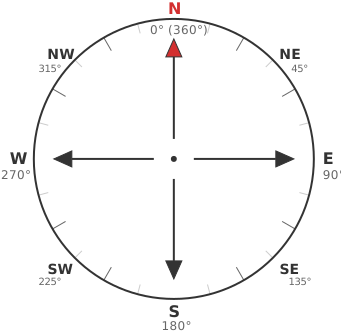
Compass/navigation convention
Extension angles report the overall outgrowth direction of a path/branch, and are determined by computing a direction vector. This vector is computed in 3D using linear regression across the path/branch coordinates, and its angle retrieved from the slope of the regression. While different angles can be obtained via the scripting API, the most common type of extension angles fall into one of two categories: absolute and relative (rel.):
绝对角度
绝对角度范围在 [0°—360°[ 之间,是根据导航惯例定义的罗盘方位角:0°:北; 90°:东; 180°:南; 270°:西。可以以 3D 形式或使用投影平面(XY、XZ 或 ZY)检索绝对角度。请注意罗盘约定和标准数学约定之间的主要区别: |————–|—————————————————————————————-|————————————————————————————————————————| | |指南针命名法|数学术语| |————–|—————————————————————————————-|————————————————————————————————————————| |参考|角度以北为参考(0° 或 360°)|角度是从正 x 轴开始测量的,即 0° | |方向[^3] |测量始终是顺时针方向|正角度是逆时针测量的。负角是顺时针测量的 | 范围:0°—360° |弧度(SI 单位)。范围:0—2π | | 单位 |度(非 SI 单位)。 |————–|—————————————————————————————-|————————————————————————————————————————|
[^3]:只有一个节点的路径没有方向。涉及此类路径的角度默认为_NaN_
路径的3D方向可以使用两个组件来捕获:
-
水平方向(方位角):遵循导航约定的XY平面(0-360°)中的罗盘方位
-
垂直倾角(仰角):与 XY 平面的垂直角度,范围从 -90° 到 +90°。例如:
0° → 水平(平行于 XY 平面); +90°→ 直线向上延伸(Z 正方向); -90°→ 直线相邻延伸(负 Z 方向)
相对 (rel.) 角度
相对角度范围在[0°—180°[ and are computed as the acute angle between a path’s 3D direction vector and its parent path’s 3D direction vector. These are thus 3D branching angles. If a path or branch has no parent, its relative angle defaults to NaN
专业角度
可以通过脚本 API 测量任何 3D 坐标组的专用角度。这包括重建(整个细胞或其部分)和 3D 网格。一些专业角度包括:
-
主轴:3D 点云的主轴表示云几何形状中最大、中间和最小方差的方向。主轴可让您深入了解 3D 表面的整体形状方向。轴是使用主成分分析 (PCA) 计算的。
-
网格曲率方向:3D 网格在特定位置的局部方向。
更多详情,请查看角度相关的demo scripts之间,例如_树网格方向分析_和_树跨度角度分析_。
Height
The height of the bounding box embedding the structure being measured
Horton-Strahler 分叉比
平均分叉比Strahler bifurcation ratios
霍顿-斯特拉勒根数
树的最高 Horton-Strahler 数,即其根节点的 Horton-Strahler 数
Inner branches
Defined as the branches of highest Strahler order. Typically, these correspond to the most ‘internal’ branches of an arbor, in direct sequence from the root. Note that Primary branches are inner branches starting at the tree’s root
See also: Primary branches, Terminal branches
内分支:延伸角
absolute(罗盘方位)extension angle inner branches
内分支:延伸角(Rel.)
relative Extension angle inner branches
内分支:延伸角 XY
XY平面内的absolute extension angle inner branches,即水平方向或azimuth angle
内分支:延伸角度XZ
XZ平面中的 absolute extension angle 和 inner branches
######内分支:延伸角ZY ZY 平面中的 absolute extension angle 和 inner branches
内部分支:长度
#####节间角 节点相邻直接邻居之间的角度(以度为单位,范围为 0-360)。即,如果节点 B 前面是节点 A,后面是节点 C,则位置 B 处的节间角度定义为支撑 AB 和 BC 之间的角度: \(\angle (\overrightarrow{AB}, \overrightarrow{BC})\)
#####节间距离 The distance between nodes defining a branch or a Path. Can be retrieved as squared internode distance when faster computations are required
Longest shortest path
The longest graph geodesic. Considering a graph-theory tree, the longest shortest path corresponds to its graph diameter (also known as maximum geodesic, or longest graph geodesic). Can only be computed for structures that are valid mathematical trees. ######最长最短路径:延伸角 absolute(罗盘方位)Extension angle longest shortest path ######端点最短路径:延伸角XY XY平面内longest shortest path的绝对Extension angle,即水平方向或azimuth angle
######端点最短路径:延伸角XZ XZ平面中longest shortest path的绝对Extension angle
######尽头最短路径:延伸角ZY ZY平面中longest shortest path的绝对Extension angle
######尽头最短路径:长度 longest shortest path的长度
Maximum geodesic
Same as Length of longest shortest path
No. of branch nodes (branch fragmentation)
The total number of nodes (and thus compartments) in a branch
分支点数量
分支点(也称为分叉点)的总数(计数)
曼哈顿数量
分支总数(统计)
一行数
fitted路径的总数(计数)
内部分支数量
最高斯特拉勒层的分支数量。通常,这些对应于乔木的最“内部”分支,从根开始直接顺序排列
路径节点数(路径节点)
路径中的节点总数(以及_compartments_)
路径数
定义结构的路径总数(计数)
#####主要分支数量 主(或根相关)分支的总数(计数)。主分支起源于树的根,延伸到最近的分支点或端点,即,它们是从根开始的_内部分支_。请注意,主分支也可以是终端分支。
刺/静脉曲张的数量
结构中所有脊柱/静脉曲张标记的总和
#####每条路径的棘/静脉曲张数量 与路径相关的脊柱/静脉曲张的数量
#####终点站数量 以端点(端点)结束的端点(计数)
提示数量
结构中端点端点的总数(计数)
总节点数
结构中节点的总数(计数)
节点强度值
每个节点位置的像素强度
节点核心
每个节点的半径,通常从 fitting procedures 获得
Partition asymmetry
L-measure metric[^2]. Computed at each bifurcation point of the structure being measured. Note that branch points with more than 2 children are ignored. Given \(n1, n2\) the number of tips on each side of a bifurcation point, Partition asymmetry is defined as: \(\frac{abs(n1-n2)}{(n1+n2-2)}\). #####路径通道 与路径关联的颜色通道(多维图像)
路径收缩
路径直线度的角度。定义见Branch contraction
#####路径延伸角度 路径的absolute(罗盘方位)Extension angle
#####路径延伸角度(相对) 路径的relative Extension angle,即路径与父路径之间形成的角度(分支角度)。 NaN 如果路径没有父路径。
#####路径延伸角XY XY平面中路径的绝对Extension angle,即水平方向或azimuth angle
#####路径延伸角XY(相对) XY平面中路径的相对Extension angle
#####路径延伸角度XZ XZ平面中路径的绝对Extension angle
#####路径延伸角XZ(相对) XZ平面中路径的相对Extension angle
#####路径延伸角ZY ZY平面中路径的绝对 Extension angle
#####路径延伸角ZY(相对) ZY平面中路径的相对Extension angle
路径框架
与路径关联的时间点(多维图像)
#####路径长度
路径中所有节点间距离的总和
See also: Branch length
路径平均半径
定义跟踪路径的节点半径的平均值
路径顺序
路径脊柱/静脉曲张密度
与路径相关的脊柱/静脉曲张标记的数量(统计)除路径康复长度
路径
通过将每个节间段视为截头体中所有截头体的瞬时求和来计算路径的_估计_瞬时[^1]
#####路径体积 通过将每个节间段视为截头圆体所有截头体的体积来求出路径的_估计_体积[^1]
#####持久性图 参见persistent homology
持久景观
#####主要分支
主分支起源于树的根,延伸到最近的分支点或端点,即从根开始的inner branches。也称为根相关分支。请注意,主分支也可以是终端分支
See also: Inner branches, Terminal branches
主分支:延伸角 XY
XY 平面内 primary branches 的绝对Extension angle,即水平方向或azimuth angle ######主分支:延伸角XZ XZ平面中primary branches的绝对Extension angle
######主分支:延伸角ZY ZY平面中primary branches的绝对Extension angle
######主要分支:长度
primary branches的长度
See also: Inner branches length, Terminal branches length
Remote bif. angles
The angle between each bifurcation point and its children in the simplified graph, which comprise either branch points or terminal nodes. Note that branch points with more than 2 children are ignored. L-measure metric[^2]
Root angles: Balancing factor
Dimensionless property related to Centripetal bias but with range \([0, 1]\). It is sufficient to produce realistic neuronal morphologies with generalized minimum spanning tree modeling. Described in: doi:10.1371/journal.pcbi.1000877 #####根角:向心偏差 Root angle analysis 公制(无量纲,范围:$$§§1§§§ 公制。单独的 von Mises 分配的平均方向(以度为单位)。
Sholl: Decay
The Sholl regression coefficient
Sholl:多项式拟合度
用于拟合肖尔轮廓的多项式次数。参见Sholl › Fitting functions
Sholl:峰度
参见Sholl › Metrics based on sampled data中的Kurtosis
#####肖尔:麦克斯 参见Sholl › Metrics based on sampled data中的Max inters.
应该:Max(已安装)
参见Sholl › Metrics based on fitted data中的Critical value
Sholl:最大(安装)半径
参见Sholl › Metrics based on fitted data中的Critical radius
应该:随
参见Sholl › Metrics based on sampled data中的Mean inters.
肖尔:不。极大值
应配置文件中_Max inters._ 出现的次数。参见Sholl › Metrics based on sampled data中的Max inters.
Sholl:次要顶部编号
应假定出现次要峰的次数。参见Sholl › Metrics based on sampled data中的Max inters.
Sholl:分支指数
参见Sholl › Metrics based on sampled data中的Schoenen Ramification index
Sholl:偏度
参见Sholl › Metrics based on sampled data中的Skewness
应该:总和
参见Sholl › Metrics based on sampled data中的Sum inters.
广场
将每个节段视为圆锥台,所有截头台的中间之和[^1]
Terminal branches
Branches ending at terminal endpoints (tips)
See also: Inner branches, Primary branches
终端分支:延伸角
absolute(罗盘方位)Extension angle terminal branches
终点分支:延伸角(相对)
relative Extension angle terminal branches
终端分支:延伸角 XY
XY平面内的absolute(罗盘方位)Extension angle terminal branches,即水平方向或azimuth angle
######车站分支:延伸角度XZ XZ平面中的absolute(罗盘方位)Extension angle 和 terminal branches
终点分支:延伸角 ZY
ZY平面中的absolute(罗盘方位)Extension angle 和 terminal branches
终点分支:长度
终点 终点 终点 分支 长度 总和
See also: Inner branches length, Primary branches length
#####TMD
拓扑形态描述符。参见persistent homology analysis
Volume
Treating each internode segment as a conical frustum, the sum of the volumes[^1] of all frusta
Width
The width of the bounding box embedding the structure being measured
X,Y,Z coordinates
Cartesian coordinates in the three-dimensional space
注释
-
此列表不包括专用模块提供的所有专用指标,例如Strahler、Sholl、Persistence diagrams/landscapes或Graph-based分析
-
某些有意义/统计数据的组合可能没有:例如,在测量单个电池时,将 cable length 与 SD 配套将无用,因为只能计算一个电缆长度值。在这种情况下,测量表连接“[单个指标]”附加到此类数据
-
100 个多个指标中的每一个都由七个统计属性表示:简单、快速、标准差 (SD)、变异系数(CV,标准差与干式的各自)、总和和 N,总共产生 \(100\times 7\) 个特征。请注意,这些特征之间存在内在图纸:例如,对于给定单元格,检索 Branch length 的 N 说明与检索 No. of branches 相同
-
报告指标的 NaN 值通常反映未定义的操作(例如除以零),或者正在解析的重建不是有效的数学树的事实
-
目前,与数量相关的指标不考虑path fillings
[^1]:体积和节点计算半径已分配给路径节点,通常通过 fitting routines.
[^2]:L-measure指标描述如下:doi:10.1038/s41592-021-01105-7
Group Statistics
SNT assembles comparison reports and simple statistical reports (two-sample t-test/one-way ANOVA) for up to six groups of cells. This is described in Comparing Reconstructions. Descriptive statistics of measurements can be obtained by running Summarize Existing Results in the Measurements dialog or by running Frequency/Distribution Analysis commands.
术语表
变异系数
变异系数 (CV) 是标准差与对照的比值。与标准差不同,CV 是无量纲的,有利于不同单位或对照(因此测量相关)的数据集之间的比较。由于 CV 表示相对于对照的变异性,也有利于比较不同群体的一致性。对照 = 100 和 SD = 10 (CV = 0.1) 的数据集与对照 = 1000 和 SD = 100 (CV = 0.1) 的数据集显示出相同的相对变异性,尽管它们的绝对变异性相当不同。虽然有用,但当均值接近零时,CV就没有意义(小分母可能会产生误差性的大CV),并且涉及负值的数据稀疏没有那么意义。
######图表 用graph-theory术语来说,树是一种没有循环的连接结构,其中任意两点之间只有一条路径。根、分支点和端点是“节点”(或“顶点”),两个节点之间的每条线段是“边”。这种数学形式通过提供标准化的分析框架,简化了涉及神经分支的形态特征的量化。另请参见Simplified graph。
######网格 网格定义了三维多面体对象的形状。在神经解剖学中,网格用于定义神经纤维注释和解剖边界,通常代表参考脑图谱内的区域室(例如,利用海马结构或物体的蘑菇体)。
多维图像
具有超过 3 个维度 (3D) 的图像。示例包括与多个荧光团(多通道)相关的荧光图像和具有时间维度的图像(延迟视频)。3D 多通道延迟拍摄有 5 个维度。
######神经突 与“神经元过程”同义。指从神经元细胞体(细胞体)延伸的任何外部,包括轴突和树突。当轴突或树突等过程的具体身份未知或与分析无关时,该术语很有用。
######(神经元)形态测量 神经元形状和结构的概念分析和测量。
######神经纤维网 神经系统中的任何区域。神经元突出周围的细胞组织。
核心外
软件架构,通过根据需要从存储设备传输数据来处理更大的可用计算机内存 (RAM) 的数据集。SNT 通过脚本支持核外部跟踪。
######路径 定义可以为一系列分支,从体体或分支点开始终止。在手动和辅助(半自动)追踪中,神经元乔木是使用路径而不是分支来追踪的。体素强度的Fitting algorithms可用于细化路径的中心线坐标,通常直到计算更准确的曲率。第三程序得到了估计与路径相关的神经突的体积
######重建 参见Tracing。这两个术语可以互换使用来描述神经元形态的数字表示。
######回报投资率 感兴趣的区域。定义要在图像处理示例过程中处理图像的特定部分。
简化图
graph的简化表示,其中沿边缘的中间“板”节点被移除,仅保留具有生物学意义的节点(根、分支点和端点)。这种简化了拓扑结构和边权重,同时降低了计算复杂性。
######骷髅 数字化形状(例如神经元重建)或二值图像的细化中心线表示。
######追踪 神经元或神经突的数字重建。该术语起源于历史上使用camera lucida设备的手动追踪技术,神经解剖学家在纸上追踪神经结构。
体积渲染
一种将图像体积显示(3D 图像)直接为3D对象的可视化技术。
本术语表根据 SNT 读者的补充注释整理如下:doi:10.1038/nprot.2008.51